
Updated: September 18, 2026
Car shots in Miami: process trailers, car mounts, driving plates and the causeway problem
A moving car is in the brief for a large share of Miami commercial work: a convertible on the MacArthur Causeway with the skyline behind, a rideshare interior on Biscayne Boulevard, a luxury sedan pulling up outside a hotel on Collins Avenue. There are four ways to put a camera on or around a moving car, and each has a different look, a different cost, a different safety profile and a different set of permits. Picking the wrong one is expensive; picking it late is worse, because the good ones need a week of planning. This guide sets out the techniques, the gear each needs, what Miami's roads and rules do to the plan, and how to decide.
The four approaches
| Technique | What it is | Look | When it fits |
|---|---|---|---|
| Process trailer | Picture car sits on a low trailer towed by a truck; camera, lights and crew ride on the trailer; the driver acts, does not drive | Any angle, any lens, controlled lighting; the gold standard for dialogue in a moving car | Dialogue scenes, hero product interiors, any shot with talent who must perform |
| Camera car / tracking vehicle | A separate vehicle with a stabilised remote head or crane arm films the picture car driving for real | Exteriors of the car moving through the city; sweeping arms; low tracking shots | Beauty exteriors, car-as-hero, the causeway shot |
| Car mounts (hostess trays, hood mounts, suction rigs) | Camera rigged to the picture car itself on suction cups or a tray; the car actually drives | Locked-off angles on the driver, the hood, the wheel; a documentary feel | Small budgets, real driving, POV and interior angles where a trailer is overkill |
| Driving plates / poor man's process | Car is stationary in a studio or on a lot; background is shot separately and composited, or an LED wall plays the plate behind the windows | Perfect control of light and performance; realism depends on the plates and the reflections | Long dialogue scenes, night interiors, anything where the road cannot be closed |
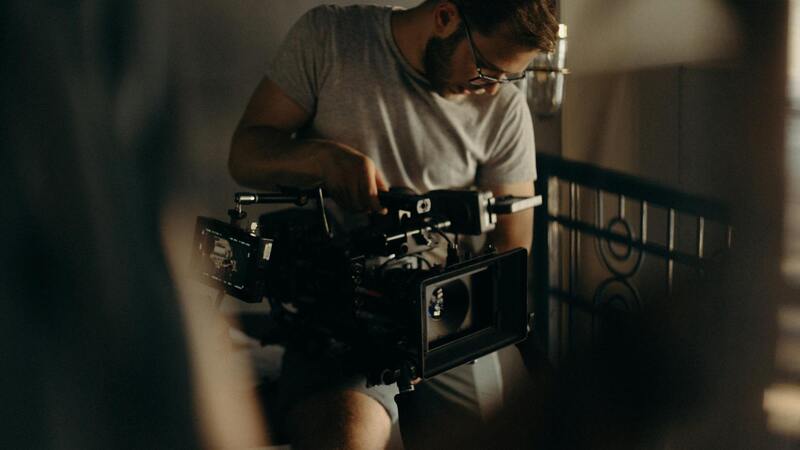
Process trailer: the most control, the most logistics
The trailer is the safe way to get talent performing inside a moving car, because nobody in frame is driving. The tow vehicle carries the generator and the crew; the trailer carries the picture car, the camera on a tripod or a rigid arm outside the windows, and the lights. Around the car you build a lighting rig: negative fill on the sky side, a soft key through the windshield or a side window, sometimes a small overhead to kill the greenhouse effect of Miami sun through glass. The shots that come off a process trailer are the ones where the audience never thinks about the camera.
The costs: the trailer and tow vehicle with an experienced driver, a police escort or lane closure on most public roads, a route that avoids low bridges and tight turns, and a slower day than a car-mount shoot. In Miami-Dade the film office coordinates with the police for moving shots, and the causeways have particular rules about speed, lane use and when a trailer can be on them; a moving shoot across the MacArthur or the Venetian is a permit with a police detail, not a drive.
Camera car: for the exteriors
A tracking vehicle with a remote gyro-stabilised head on a crane arm is what produces the shot of the car gliding along Ocean Drive or crossing the bridge with the city behind. The picture car is driven by a professional or a precision driver, the two vehicles hold formation, and the camera operator and the arm technician ride in the tracking car with wireless monitoring. The arm can place the lens a foot off the road or ten feet up, and the stabilisation removes the road. Miami's bridges and their approach ramps are the classic locations, and they are exactly where the police escort matters: you are running two vehicles in formation at low speed on a road other people are using.
Budget for the tracking vehicle with its crew, the head and arm, a precision driver, the police detail, and a rehearsal pass. The wide-open causeway shot at golden hour is fifteen minutes of usable light; the plan around it is covered in our note on shooting golden hour in Miami.
Car mounts: real driving, small crew
Suction-cup rigs on the hood, the side glass or the rear; a hostess tray hanging off the door for a profile of the driver; a small camera inside on a suction mount looking back at the passengers. The car really drives, on public roads, with the talent behind the wheel. This is legal and common for content that needs a real-driving feel, with three conditions: the driver is a competent, insured person actually driving; the rig is checked by a grip who does this regularly, with safety cables on every camera; and the speeds are low. Anything a distracted driver could not do safely is a process-trailer shot, and a producer who asks talent to act to camera while driving in traffic is taking a risk that no insurance fully covers.
Mounted cameras need small bodies, remote start or long-record, and lenses chosen for the fixed angle; our guide to camera support gear covers the rigging hardware. Sound inside a moving car is tyre and wind; plan lavs and expect ADR.
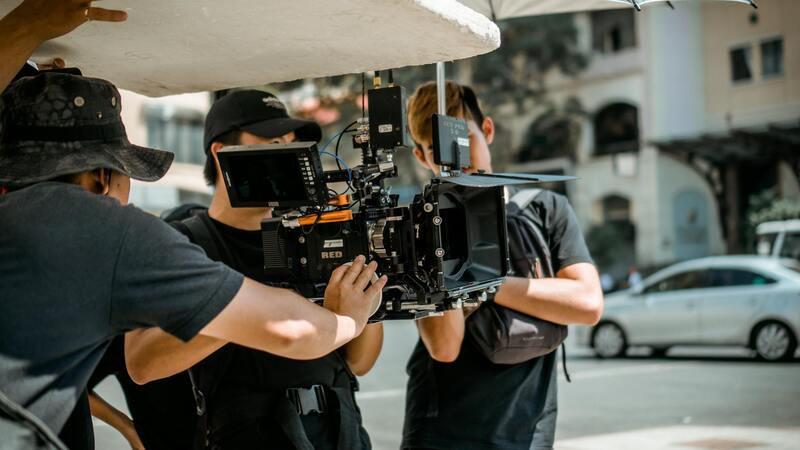
Driving plates and the LED wall
When the scene is long, the light must stay constant, or the road cannot be closed, the car does not move. The background is shot as plates (a camera car drives the route with a multi-camera array recording forwards, sideways and backwards) and either composited behind the windows in post or played back on an LED wall around the stationary car on a stage. The LED approach gives real reflections in the paint and glass and lets the DP light the interior for the plate; the composite approach costs less up front and more in post. Both need the plates shot with the same lens angles and at the same time of day as the scene, and both need the car's windows and reflections managed by a grip who understands what the wall does to a windshield. Green screen behind a car is the older version of the same idea; where it still works is described in our note on green screen production.
Choosing
- Dialogue in the car, day: process trailer.
- Dialogue in the car, night, or a long scene: stage with plates or LED wall.
- Exterior beauty of the car moving through Miami: camera car with a stabilised head.
- Real-driving feel, small budget, short shots: car mounts with a real driver and a grip.
- Any combination: shoot the exteriors with the camera car and the interiors on the trailer or the stage; the audience will not know.
Whatever the choice, the picture car itself is a production issue: it must be clean to a standard a still photographer would accept, it must not show its reflection of the crew, and a second identical car for the exteriors while the first is being rigged saves half a day.
Car work with our crews
We rig and shoot moving-car work across Miami with the right tool for the shot: process trailers with our lighting rigs for interiors, a tracking vehicle with a stabilised remote head for causeway and street exteriors, grip-rigged car mounts with safety cables for real-driving content, and stage-based plate and LED-wall work when the scene needs control. The film office permits, police details and route planning for the bridges are part of the package, and we scout the route at the shooting hour for traffic and light. If a car is in your project, tell us which shots are exteriors and which have talent speaking, and we will propose the technique per shot with the costs side by side. Start with the contact page; our camera and lighting capabilities are on the about page.